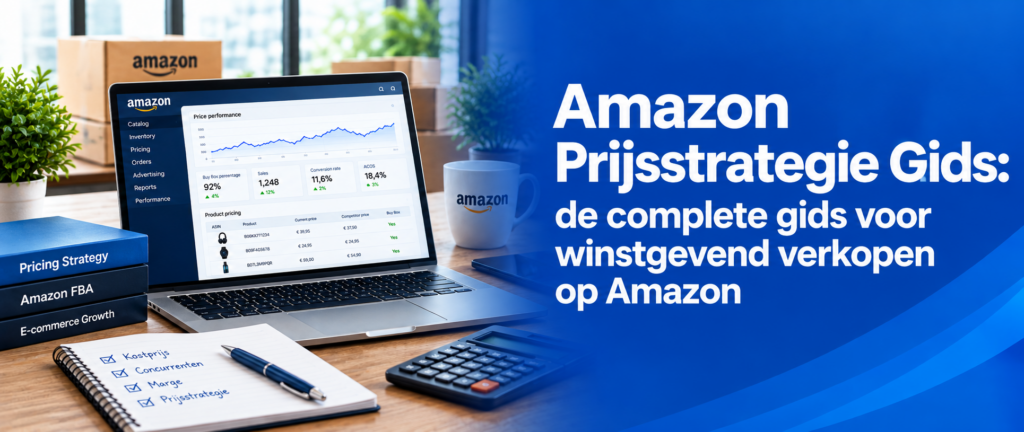
The best Amazon pricing strategy combines a profitable minimum price with competitor analysis and regular price optimization. You want to remain competitive and win the Buy Box where relevant, without sacrificing unnecessary margin. Therefore, look not only at competitor pricing, but also at your actual costs, ad performance, and total revenue.
A price reduction can lead to extra sales, but at the same time worsen your profitability. Conversely, a higher price can generate more profit, even when you sell fewer products.
In this Amazon pricing strategy guide, we share three practical SellerHQ hacks to help you make better-informed pricing decisions.
1. What is a good Amazon pricing strategy?
An effective Amazon pricing strategy takes into account your costs, competition, product value, and market developments.
Do you sell identical products to other providers? Then price, delivery time, and sales performance play an important role in your competitive position. With private label products, you have more room to justify your price through quality, reviews, and brand positioning.
For beginning sellers, a simple Amazon pricing strategy is the best starting point: first calculate your minimum profitable price, and then add competitor analysis and any automation.
The right price is not automatically the lowest price, but the price that yields the best balance between sales volume and profit.

2. First, calculate your minimum profitable selling price
Before you lower prices or let them adjust automatically, you need to know how much margin actually remains.
Take into account purchasing and shipping costs, Amazon commissions, fulfillment, storage, expected returns, and advertising costs.
SellerHQ Hack 1: Calculate your price limit including advertising costs
Suppose you sell a product for €39.95 excluding VAT.
Element | Amount |
Selling price | €39.95 |
Purchasing and transport | €12.00 |
Amazon commission | €6.00 |
| Fulfillment and other variable costs | €5.00 |
| Contribution before advertisements | €16.95 |
With an ACOS of 20% on an advertising-driven sale of €39.95, you pay approximately €7.99 in advertising. That leaves about €8.96 for that sale, before any other fixed costs and taxes.
Our approach: determine in advance what minimum contribution per product is acceptable. Then calculate how much room you have for price reductions and advertising costs.
Furthermore, do not use a single fixed ACOS for all sales: organic and ad-driven orders have a different cost structure.
The amounts are fictitious and intended solely as a calculation example.
3. Analyze competitor prices without immediately lowering your prices as well.
Amazon is a competitive marketplace, but following every price drop is rarely wise.
Compare not only competitors’ selling prices, but also their delivery times, product content, reviews, and availability.
A product priced at €34.95 is not automatically more attractive than your product priced at €39.95 when your offer demonstrably provides more value.
For identical products, the total offer plays an important role for the Featured Offer (Buy Box). However, the lowest price does not automatically guarantee a Buy Box position.
SellerHQ tip: for own-brand products, focus primarily on the price-quality ratio. For identical products, the emphasis is more on price, availability, and delivery.
4. Use dynamic pricing, but avoid a price war
A dynamic pricing strategy on Amazon means adjusting prices based on changing market conditions, such as competitive pricing, inventory levels, and seasonal demand.
Repricing software can automate this process, but always establish a minimum profitable price and clear pricing rules. This prevents automatic price reductions from leading to a price war.
The goal of dynamic pricing is not to always be the cheapest, but to remain competitive without sacrificing your margin.
5. Combine pricing strategy with Amazon data and AI
A price change can impact your conversion, ad performance, and total revenue. That is why, at SellerHQ, we do not evaluate prices in isolation from other marketplace data.
SellerHQ Hack 2: Analyze the effect of price changes with AI
Combine, for example:
- Business Reports: revenue, units sold, sessions and conversion.
- Advertising Reports: advertising revenue, ACOS and advertising costs.
- Search Query Performance: click-through and purchase share for relevant search queries.
- Competitive data: price developments, availability, and product positioning.
Suppose you lower the selling price by 5% and subsequently sell 15% more units.
That seems like an improvement. But if your contribution per product drops by 25%, your total profit can still decline.
With AI, you can compare price periods, recognize patterns, and identify products where a price change might be beneficial.
Our approach: assess price changes based on their impact on total contribution and profitability, not just on revenue growth or conversion.
Take other changes into account, such as advertising budget, seasonal influences, and competition. A change in revenue is not automatically caused by the new price.
6. Align your pricing strategy with your advertising campaigns
Pricing and advertisements are often optimized separately, while they strongly influence each other.
A lower selling price can improve conversion, but simultaneously reduces the margin available for advertising. A higher price, on the other hand, can yield a higher margin per sale, but also affect conversion.
SellerHQ Hack 3: Don’t automatically increase your advertising budget at a lower price
Suppose you offer a product at a lower price temporarily and sell more as a result.
Before adding extra advertising budget, check:
- What is the new contribution per product sold?
- How is the conversion developing?
- How are ACOS and TACOS changing?
- Does the combination of price and advertising budget actually yield more profit?
Sometimes a higher selling price with fewer units sold is more profitable than an aggressive price reduction with additional advertising expenses.
At SellerHQ, we therefore optimize not solely for advertising return or sales volume, but for the contribution of both to overall marketplace performance.

Conclusion: A profitable Amazon pricing strategy requires more than competitive prices.
A profitable Amazon pricing strategy is not about the lowest price, but about the right balance between margin, competitive position, and sales volume.
By combining pricing with Amazon data, AI, and ad performance, you can make better-informed decisions.
SellerHQ helps brands bring together pricing strategy, advertising, and marketplace data for profitable growth.
Discover our services at SellerHQ.nl .
Frequently asked questions about Amazon pricing strategies
What is the best pricing strategy for Amazon?
There is no universally best strategy. For identical products, competitive pricing is important, while distinctive brands have more room for value-based pricing. Always start with a minimum profitable price.
What is a good Amazon pricing strategy for beginners?
Start by calculating your actual costs and minimum profit margin. Next, compare competitor prices and test small adjustments before switching to automated price optimization.
Is a dynamic pricing strategy on Amazon suitable for small sellers?
Yes, especially when you compete with other providers of the same product. However, do set clear minimum prices and pricing rules to prevent automatic price reductions from eroding your margin.
How does my selling price affect the Buy Box on Amazon?
The total price is an important factor for the Featured Offer, but delivery and seller performance also play a role. Therefore, the lowest price does not automatically guarantee the buy box position.